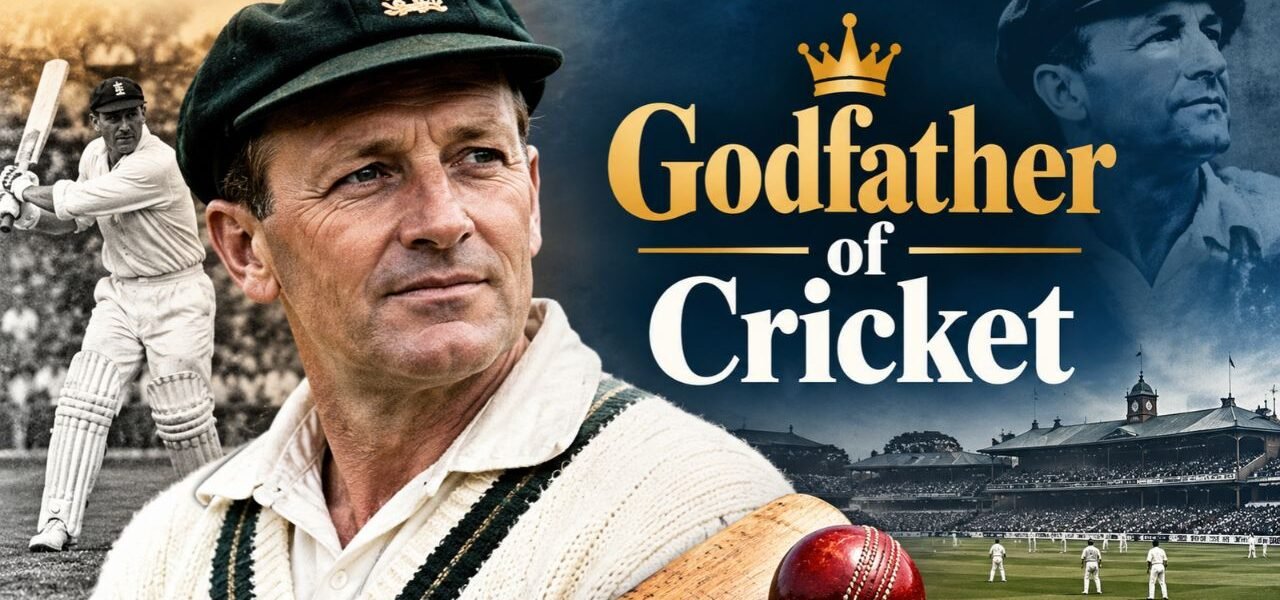

The game of Cricket is one which is deeply entrenched in its history, with great players and administrators, trend-setting coaches and inspirational leaders. Throughout the years, some people have been credited for making a significant impact on the establishment of the sport that entitled them to such monikers. The title of “Godfather of Cricket” is one of the most despicable titles in cricket. But who is actually deserving of this infamous title?
The truth is more complex than it may first seem. The term can mean a wide variety of personalities depending on the context, country, time frame or aspect in cricket being discussed. But W. G. Grace is regarded by most as an early pioneer and a highly influential figure in the emergence of modern cricket, though he did not play for England until 1880, long after many other British cricketers have played numerous Tests before him). He became almost a myth in cricket history, an achingly large personality dominating his phenomenal career and his place in the game.
At the same time, Sir Donald Bradman, Kerry Packer and modern cricket administrators have sometimes been variously labelled with paternal and godfather analogies through their impact on specific areas of the game.
In this article, we talk about what it means to be “the Godfather” of cricket, why W. G. Grace is inextricably tied with the title and looks at other men who were instrumental in changing the course of Babu’s game forever.
Who is Referred to As a Symbol of Cricket?
W. G. Grace surely ranks as the strongest candidate for the historical godfather of any sport, in light of his immense impact on cricket through its formative years in the critical Victorian era. Arguably the most famous cricketer of the 19th century, W. G. Grace had his first match in 1848 and heavily influenced cricket as we know it today. His legacy lives on to this day and platforms like CrikZoo strive to nurture that rich cricketing legacy by arranging the past, present and future of cricket as a common theme bridging generations.
His influence extended beyond statistics. Grace drew massive crowds and attention from the press and helped take cricket from a sport played for leisure to one of the biggest spectator sports. That is why to call him a godfather of cricket is not only a statement about his own playing, but about who he was in the culture.
W. G. Grace, The Godfather of Cricket?
W. G. Grace we are fine with, as far as his influence on early cricket you would be hard pressed to dismiss it which is how he got the tag godfather of cricket Grace was at one time almost English cricket. He could draw a crowd and newspapers of the time regularly filed reports on him.
Grace accumulated unbelievable statistics while playing first-class cricket for many decades. He had been going for longer than it is often written in the football world. He remains a legend in not just English cricket but of world cricket as well, and continued playing top-level cricket until his 50s; proof to his incredible fitness and love for the game.
There were a couple of things that made Grace so impactful:
- He was one of the leading figures in making cricket popular with the general public.
- The way he batted changed the course of many players for generations to come.
- With his vivacious personality, he became one of the first cricket superstars.
- Spanning different generations of cricket, his career was the bridge that linked them all.
- His name quickly became synonymous with English cricket itself.
This partly explains why, to this day, Grace stays at the top of the tree among the gameś chief guru.
The Role of W. G. Grace in Transforming Cricket Popularity
If we look at the way in which cricket progressed through the 19th century we can see the significance of W. G. Grace Things were getting quite formalised in the sport now, but still needed larger than life characters to galvanise public interest. and this is precisely that kind of character Grace became. It was a landmark in the history of sports entertainment, where spectators were often as interested in seeing Grace himself as they were in watching any one team play.
He did a lot to help bring cricket to the masses. Readers who followed his career could relate to his victories and losses, while newspapers had a material with which to fill their sports pages. Thus Grace helped both to create cricket as a competitive sport and as public entertainment. His association with the Godfather of Cricket becomes all the more significant in light of this combination of performance and popularity.
W. G — How W. G Grace Ushered in Cricket as an Early Celebrity
Dressed up in the cocoons of an international superstar of that manner fitters in millions accustomed to fallible fans who have pledged as dipping and accountable interest every four years know better than the promoted day cricket, where advertisements are virtually unbroken fuzz entirely around. This is the era of television age, social media and sports marketing but celebrity in cricket predates that too.
Far and away no cricketer in any era previously or since did more to drag the game front and centre into public consciousness than W. G. Grace; possibly the first cricket superstar His fame extended far beyond the cricket field, his trademark beard and commanding presence made him instantly identifiable. When newspapers still dominated sports news, he was a familiar face.
Grace shaped interest in the fact that a cricketer could be bigger than the game. Well, he was so much an umami of a public flavour that the people used to come in just for him. In that way he paved the path for modern day cricket superstars.
That is the reason why this godfather of cricket notion suits Grace like a glove, as he was responsible for making cricket the game with larger than life personalities.
SIR William Gilbert Grace, aged 120 A.D.
Even by popular standards today, Grace’s stats still look impressive. He had a stupendous first-class career, with 54,000-plus runs in the longest format. And he cracked hundreds of centuries in his career and bagged thousands of wickets.
And what makes these accomplishments even more incredible is the microwave period he played in. Cricket was a very different game when Grace played it compared to the professional sport they have today. Cricket players did not have the modern fitness science, specialist coaching or advanced protective gear — let alone any of the high-performance training programs used by professional cricketers today.
Grace depended primarily on natural talent, stride length, experience and stamina. He was remarkable for his longevity, being a major figure in English cricket for several decades.
His career thus serves as a critical link between the early days of codified cricket and contemporary sport.
Did W.G. Grace Invent Modern Cricket?
W. G. Grace did not invent cricket, though to put it that way is an over-simplification of history. The sport had existed for centuries prior to his birth and thousands helped advance it.
But it was Grace who had an enormous hand in popularising and defining the culture of contemporary cricket. The way he played the game shaped players’ thoughts on attacking cricket, and his stature as a person brought eyeballs to it.
By the 19th century, cricket was beginning to evolve into an organized sport but Grace became one of its most famous proponents. His impact created the notion of a cricketer becoming a figurative national sporting icon.
In this sense the label godfather of cricket should not be interpreted literally as a claim that he built cricket, just as it has to be clear that wealth being shared is not social justice.
The Career Of W. G. Grace: An Extraordinary Life
Grace’s stats would still look great even today. He played a phenomenal volume of first-class matches The difference between the Godfather and Father of cricket
What one must know is that “godfather of cricket” and “father of cricket” are not official terms.
Over the years, cricket historians and fans have used various fables for people who had lasting impact. Where some are tied into specific accomplishments, others are not so serious accolades.
The term “godfather” usually hints at someone larger than life who greatly influenced the evolution, culture or popularity of something. So in cricket parlance, this could mean someone whose impact altered the sport at its roots.
As we begin to unpack this notion of a father, which is not always used in the same sense since history can be different. Consequently, the reader should always ask themselves who they are referring to and why is that title being used.
Other Contenders For Being Called The Godfather of Cricket
While W. G. Grace is one of the easier historical answers, cricket has thrown up a number of other grizzled characters who could be considered godfather-like figures in certain contexts.
Sir Donald Bradman and His Great Impact
Indeed, Sir Donald Bradman is billed as the greatest batsman to have ever played cricket. The Australian legend has ruled Test cricket for long to a point where his name became the benchmark for batting.
One of the best known statistical landmarks in sporting history is Bradman’s Test batting average of 99.94. His success made him an Australian sporting icon, and a cricketing legend all over the world.
Although sometimes described as the godfather of cricket, Bradman is more often read in the context of ‘the greatest cricketer of all time’, but that doesn’t mean his impact wasn’t immense – on batting technique and sporting culture and in establishing cricket’s international reputation. He has scored more than 54,000 first-class runs. In addition, he amassed many hundreds of centuries in his career and more than thousands wickets.
You know what adds to the impressive nature of these feats, is the era in which he did so. Cricket in Grace’s era was a complete far cry from the professional game we have now. Players lacked access to modern fitness science, specialist coaching, state-of-the-art protective equipment or any of the contemporary cricketers’ elaborate training regimens.
Grace has ability, skill, experience and toughness in abundance. His lifespan was extraordinary, he remained a potent force in the world of English cricket for so many decades.
Thus his career spans a significant gap between the era of amateur organized cricket and that of professional sport.
Was W. G. Grace the Inventor of Modern Cricket?
It would be a great exaggeration to claim that W. G. Grace invented cricket. The sport had been around for hundreds of years before he was even born, and there were many people who helped shape it.
But it is Grace who had an immense hand in establishing and developing the culture of modern cricket. His batting method impacted the minds of players about aggressive cricket and his fame attracted a lot of crowd attention to this sport.
The 19th century was already seeing cricket become an organized sport at that stage and while Grace became one of its best-known ambassadors. In essence, he paved the way for cricketers to be considered a national sporting hero.
Hence the term godfather of cricket: while it sounds grandiose, no one is suggesting he played any part in fashioning or founding the game itself.
One of the Greatest and Perhaps The Greatest Cricketer W. G. Grace
Even from a contemporary perspective, Grace’s numbers are still impressive. He played tons of first-class cricket and was the kingpin in the earlier days, built massive records and amassed over cricThe Difference Between The Godfather Of Cricket And The Father Of Cricket
Keep in mind that these “godfather of cricket” and “father of cricket” are not exactly official.
Over the years, various cricket historians and fans have described great players with different epithets. Some designations reflect milestones in performance, while others are less formal expressions of esteem.
Factors that help with this are its of the phrase; The word “godfather” usually implies a man who had great influence over the idea, culture or visual impact of something. In cricket parlance, this can then mean one whose milieu bore the influence on how a sport was defined in absolute terms.
The word “father” has a nearly equivalent sense but is sometimes applied to different people depending on the context of history. As a result, readers should be wary of who we are talking about as well and why that specific title is being used.
Other players who could be labelled as the Godfather of cricket
While W. G. Grace is among the most plausible historical responses, cricket has a few other god-fathers in the archive.
Sir Don Bradman And His Greatest Impact
Sir Donald Bradman can be considered as the greatest batsman that cricket has ever given birth to. The Australian legend was such a force in Test cricket, his moniker all but became interchangeable with a conventional batting class.
Perhaps the most famous statistic in sporting history is Bradman’s Test batting average of 99.94. His success made him an Australian sporting icon, and a global cricketing legend.
Although Bradman is more often referred to as one of the greatest players, than as the godfather of cricket, his effect on batting technique, sporting culture and international standing for cricket were immense. Raised more than 54,000 first-class runs during this time. He also scored hundreds of centuries and took thousands of wickets in his career.
The era he played in makes these achievements all the more remarkable. Cricket as it was in Grace’s day bears little resemblance to the modern professional game. These players were not helped by modern fitness science, specialist coaching, advanced protective equipment or the kind of sophisticated training programs cricketers are exposed to these days.
Grace drew from natural talent, skill, experience and the physical side of it. What was even more phenomenal than his freshness? His longevity–he held the position of an English cricket great for over three decades.
This makes his career a vital link in the evolution of the game from early organised cricket into its modern form.
W. G. Grace and the Invention of Modern Cricket
Let us make one thing clear at the outset: W. G. Grace did not invent cricket. Although the sport began centuries before his birth, and developed by several people.
Grace did help immensely with that though, as modern cricket was practically molded and defined in the era of Grace. His style of batting shaped how players perceived attacking cricket and also his star power drew people towards the game.
Cricket was already becoming a neat, organized sport in the 1800s, but Grace became one of its better-known ambassadors. That a cricketer could be a national sporting icon was an idea that he helped cement as possible.
So interpretation of the term godfather of cricket is symbolic and should not be said as he invented cricket.
How Kerry Packer Changed the Face of Cricket
Then there’s Kerry Packer, who interpreted the godfather of cricket somewhat differently. The Australian media tycoon transformed professional cricket via World Series Cricket in the late 1970s.
Packer’s innovations, such as coverage on TV, contract plays, colour clothing, day-night cricket and professionalism. They brought with them the changes associated with World Series Cricket many of which are considered commonplace by modern cricket fans.
It was not just about batting or bowling and there was no way I could contribute through that. No, it was about making cricket an even better television sport in a more commercially savvy way.
This is why Packer can be considered something of a godfather to modern commercial cricket.
Read also: Who Is the Father of Cricket | Lucknow Super Giants vs KKR Timeline | Gujarat Titans vs Lucknow Super Giants Timeline
Kerry Packer: The Godfather of Modern Cricket
If you turn the question to What is a virtual console for popularizing early cricket? to be named “The Man Who Changed Modern Professional Cricket”. In that context, Kerry Packer is an immensely significant name.
Until the advent of World Series Cricket, international cricket was relatively conservative in both its commercialization and presentation. Packer broke the mould and showed that top cricketers could both dominate TV news bulletins and become genuine showbiz stars.
Shane Warne and backing: How cricketers helped revive tests World Series Cricket WSC was the first to introduce much of what has subsequently permeated international cricket, such as floodlit games and more potent televised presentation.
To set the record straight, Packer was not a cricketer but his imprint on cricket was enormous. Herein lies why the godfather of cricket can be understood in different ways based on whether the context is around playing, administration, commercialisation or pop culture.
The Title of Godfather of Cricket Is so Difficult to Define
There is no one definition for the title godfather of cricket, certainly not like there is a universal clamouring for the official cricket awards. But the phrase may apply to different people depending on which fans you ask.
An example is someone whose interest in the formative years of cricket can choose W. G. Grace (Although I would). Be it a person speaking about the best Test batsman would look at Don Bradman, while someone tackling cricket’s cash cow argument may opt for Kerry Packer.
This debate can thus be classified under the following headings:
| Area of Influence | Important Figure | Main Contribution |
| Early cricket popularity | W. G. Grace | Popularized cricket and became an early sporting icon |
| Batting excellence | Don Bradman | Redefined Test batting standards |
| Commercial cricket | Kerry Packer | Transformed professional cricket and television coverage |
| Indian cricket influence | Sachin Tendulkar | Inspired generations and expanded cricket’s cultural reach |
| Modern Indian leadership | MS Dhoni | Transformed expectations around limited-overs captaincy |
That shapes the conversation in a far more exciting direction than just picking one name.
W. G. Grace — The Greatest Cricketer Ever?
To be associated with the godfather of cricket does not automatically make W. G. Grace the greatest player who ever played. The sport has changed so much that comparing players from different eras is almost impossible.
With things like state-of-the-art equipment, sliced professionals, fitness specialists, video analysis, nutrition planning and very competitive international schedules. Players from Grace’s era dealt with an entirely different set of circumstances.
Maybe Grace’s legacy is mainly historical. He was instrumental in throwing cricket to a national spectator sport and one of its first iconic personalities Statistically, too, he was no slouch but culturally perhaps even more so.
So he may be remembered as one of the game changing icons in cricket rather than to be viewed only with an eye on modern criteria for performance.
Perhaps the most significant impact that Grace had on his times was in altering people’s perceptions of cricketers. Prior to the days of sports celebrity, players really only became household names in their own communities. Grace evolved into a fully recognizable public figure whose identity was fused with that of cricket.
From appearance, personality and charisma to time in the limelight, he was natural fodder for the public memory. This was further aided by newspaper coverage of his performance and spectators turning up at matches just to watch him play.
Grace, in many ways, laid the foundations of a template that modern cricket has built on: a fantastic player who becomes an embodiment of the game itself.
A cultural legacy is among the main factors why his name fell so closely linked with the title godfather of cricket.
Impact of God Father of Cricket on Future Generations
W. G. Grace loomed large even beyond the end of his playing days, however. His legacy continued to motivate future generations of cricketers and historians.
The game that they took over was highly organized, ever-growing in popularity and of major commercial significance. The twentieth century saw cricket evolve into an international pursuit played by men from numerous lands as professionals.
The game evolved over the years contributed by the modern legends like Sachin Tendulkar, Brian Lara, Ricky Ponting, Jacques Kallis and Virat Kohli on their terms. But figures like Grace laid the foundations for cricket’s celebrity culture.
The Relevance of the Godfather of Cricket Today
The term godfather of cricket continues to keep its relevance at least as cricket keeps changing. Players and personalities of each generation shape how the game is played, presented, sold and appreciated.
The cricket of Grace’s era is a far cry from the cricket of today. ODIs and T20s have been invented, Test cricket languishes alongside them, international games are aired worldwide, leagues draw gigantic viewership, players have a direct channel with the fans via social media.
But the concept itself is consistent: the best players can impact on which way and how famous this game will go.
More than a century ago, Grace demonstrated this tenet, and the games modern-day titans of cricket pay homage to that foundation.
Godfather of Cricket vs Contemporary Cricket Legends
Perhaps this is no surprise to more modern fans who would associate greatness in cricket with names like Virat Kohli, Sachin Tendulkar, MS Dhoni or Ben Stokes. These players boast millions of fans from all around the world and their records in the modern era speak volumes.
But their notoriety is born into an entirely different media ecosystem. Nowadays, players have their place on social media; they are seen as a star in streaming services, international leagues that use personalised sponsorship contracts and invest money into promoting them with global appeal.
Or W. G. Grace, the quintessential cricketer, who became extraordinarily famous in an age before any of these technologies even existed. His popularity was built through performances, newspapers, word of mouth and his sheer presence.
That comparison only underscores what an impressive historical role he played.
Conclusion: Godfather of Cricket Out in the End
W. G. Grace comes to mind as one of the strongest possible, and most defensible answers you could come up with if you were talking about a historical context when the phrase godfather of cricket is used. He was not the inventor of cricket but he did so much to popularise the game and make a cricketer one of knowable sporting personalities.
His spectacular career, remarkable statistics, unique persona and impact on the game culture certainly made him one of sport’s most monumental figures in the early modern age.
Despite the title, the meaning of it can change depending on context. You have Sir Donald Bradman, the be all and end all of batting prowess, Kerry Packer who revolutionised the game’s commercialisation and television coverage. Pioneers of the game like Sachin Tendulkar and Virat Kohli took cricket’s cultural cachet into whole new stratospheres.
In the end, W. G. Grace should be remembered as one of the cornerstones, on which all that is cricketing celebrity stood. His legacy proves that a sport is not defined by runs, wickets, and trophies alone. Other times, it is determined by the degree to which one vaporizes and becomes absorbed into the identity of the game itself.
FAQs:
1. Who is known as the Godfather of Cricket?
W. G. Grace is widely associated with the title Godfather of Cricket because of his exceptional career and influence on early modern cricket.
2. Why is W. G. Grace called the Godfather of Cricket?
W. G. Grace helped popularize cricket, attracted huge crowds, and became one of the sport’s earliest famous personalities.
3. Did W. G. Grace invent cricket?
No. Cricket existed long before Grace was born. However, he played a major role in popularizing and shaping the sport during the 19th century.
4. Who is the Godfather of modern cricket?
W. G. Grace is often linked with the historical title, while Kerry Packer is widely recognized for transforming the commercial and television side of modern cricket.
5. Is W. G. Grace the greatest cricketer ever?
Not necessarily. Grace is one of cricket’s most influential historical figures, while players such as Don Bradman and Sachin Tendulkar are often ranked among the greatest ever.
Read also: Lucknow Super Giants vs Punjab Kings Timeline | Most Famous Cricketer in the World