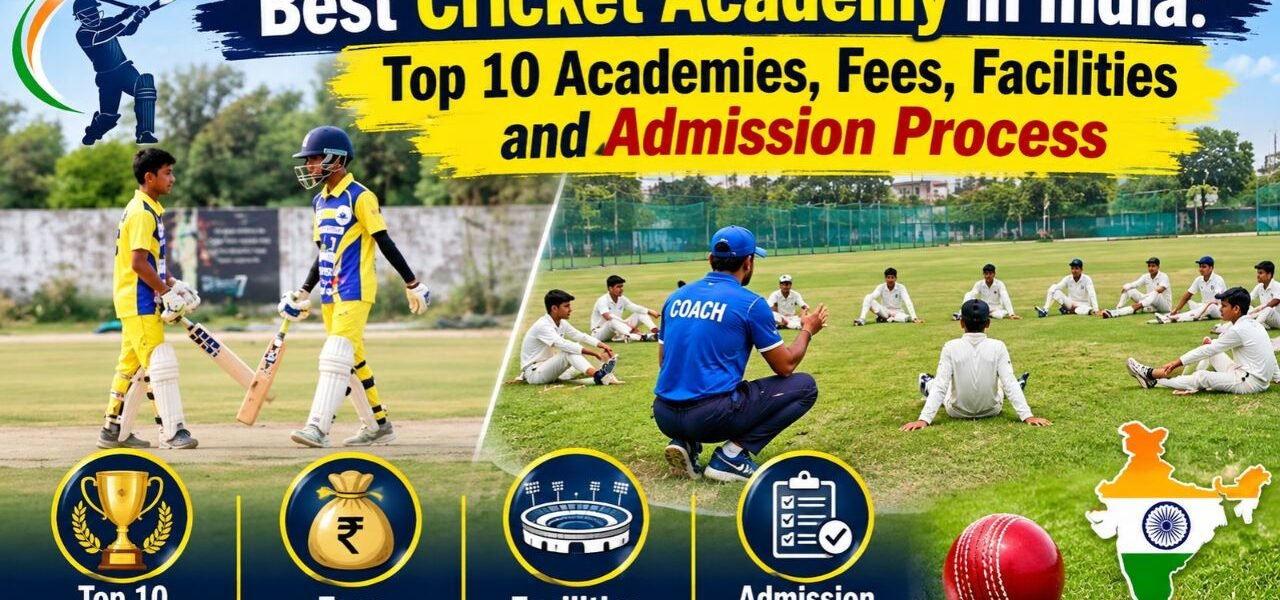
Best Cricket Academy in India: Top 10 Academies, Fees, Facilities and Admission Process

In order to become a professional cricketer, choosing the right cricket academy will be a crucial first step. There have been several great Indian cricketers such as Sachin Tendulkar, MS Dhoni, Virat Kohli, Rohit Sharma, and Jasprit Bumrah that have inspired numerous young people to pursue their dreams of playing cricket. While there are a lot of factors involved in being successful at this level (such as having a great coach, practicing regularly, staying physically fit, and getting enough competitive match play) the most important factor is developing those skills. The top cricket academy in India can provide aspiring cricketers with expert advice on how to improve their game, a structured approach to improving their game, and opportunities to compete with other aspiring cricketers.
Top 10 Best Cricket Academies in India
In India there are many cricket academies that help develop young cricket talent and prepare them to play at a competitive level. Some academies provide full coaching programs while other academies focus on developing specific skills like batting or fast bowling, and advanced training. Crikzoo provides its readers with up-to-date information on cricket related news and insights. Below is a list of ten of the top cricket academies in India, along with what types of coaching services and training options they offer.
1. National Cricket Academy (NCA), Bengaluru
The National Cricket Academy (NCA), based in Bengaluru, is one of the top-rated cricket development facilities in India. It was founded by the Board of Control for Cricket in India (BCCI) in 2000, as a means to find potential talented cricketers and give them specialized training. Today, the NCA is part of the BCCI Centre of Excellence, which provides cricketers with high quality coaching, physical conditioning programs, recovery from injuries, and performance enhancement. There are numerous cricket coaching schools throughout India; however, the NCA works with only those selected players that can demonstrate their ability to perform competitively at a level above that found in standard cricket coaching programs. As such, the NCA is an integral part of developing young, promising, and elite-level cricketers as they look to reach new heights within the game of cricket.
Key Highlights:
- Advanced cricket training and performance development.
- Professional fitness and rehabilitation support.
- Technical and tactical skill improvement.
- Training opportunities for selected talented cricketers.
Location: Bengaluru, Karnataka.
2. Karnataka Institute of Cricket (KIOC), Bengaluru
The Karnataka Institute of Cricket (KIOC) is one of the most well known cricket coaching schools in Bengaluru. KIOC offers structured training programs that help players at varying levels of their cricket careers. Players attending KIOC will receive professional instruction to enhance their batting, bowling, fielding, and game awareness through daily training drills. KIOC’s training methodology is designed to provide players with a solid foundation in the sport of cricket so that they can continue to grow and develop as a player over time. Through continuous practice, students can recognize what areas need improvement, create new ways to execute skills, and become aware of various scenarios during a match. Prior to registering, potential students should review the current training schedules, coaching staff assignments, facilities provided, and whether there are options to compete in matches.
Key Highlights:
- Coaching for different skill levels.
- Focus on batting, bowling and fielding.
- Regular training opportunities.
- Structured cricket development programmes.
Location: Bengaluru, Karnataka.
3. Sehwag Cricket Academy, Jhajjar and Delhi NCR
Sehwag Cricket Academy has become an attractive choice for aspiring young cricketers. It was founded by ex-Indian cricketer Virender Sehwag. The academy’s main facility is located at Jhajjar, Haryana (just outside of Gurgaon). It was established in 2011 with the goal of providing quality cricket coaching and professional development. The academy’s coaching curriculum includes technical skill development, tactical knowledge, physical conditioning, and mental preparation for the game. Students have the opportunity to develop their batting, bowling, and fielding abilities as well as learn how to apply these skills during competition. Additionally, the academy provides regular opportunities to participate in matches and receive hands-on experience which assists young players to appreciate the importance of discipline, teamwork, and consistency.
Key Highlights:
- Founded by Virender Sehwag.
- Structured cricket coaching programmes.
- Focus on technical and mental development.
- Match practice and tournament exposure.
- Opportunities for young cricket enthusiasts.
Location: Jhajjar, Haryana, and selected Delhi NCR centres.
4. MRF Pace Foundation, Chennai
The MRF Pace Foundation (Chennai) is one of the most significant institutions for young fast-bowlers. Founded in 1987 by Dennis Lillee, a former Australian fast-bowler, the foundation has been a major contributor to the growth of fast-bowling talent in India. While there are many cricket coaching centers throughout the country, the foundation is unique in that it focuses exclusively on pace bowling and works to help players enhance their run-up, bowling actions, speed, accuracy, and physical fitness. Since fast bowling requires tremendous amounts of energy, flexibility, endurance, and proper form, young fast-bowlers need the assistance of professionals who specialize in fast bowling. Players who wish to make a living as professional fast-bowlers should investigate what the MRF Pace Foundation has to offer them.
Key Highlights:
- Specialised fast-bowling development.
- Technical guidance for bowling actions.
- Focus on bowling speed and accuracy.
- Physical conditioning and injury prevention.
Location: Chennai, Tamil Nadu.
5. Sonnet Cricket Club, Delhi
The Sonnet Cricket Club is one of the oldest and most respected clubs in the Delhi area for developing young cricketers. It has been providing young cricketers with opportunities to practice regularly and compete in matches since its inception. The Sonnet Cricket Club is known for producing technically good cricketers. The Sonnet Cricket Club provides a supportive and encouraging environment for aspiring cricketers to improve their batting, bowling and fielding techniques. Practical match experience is one of the most important components of becoming a successful cricketer. Players gain valuable experience handling pressure, understanding the various scenarios they may encounter during a match, and ultimately making better decisions while playing. Young cricketers looking to develop their skills within a competitive cricketing atmosphere should consider joining the Sonnet Cricket Club.
Key Highlights:
- Established cricket coaching environment.
- Focus on technical improvement.
- Opportunities for competitive cricket.
- Training for developing young players.
Location: Delhi.
6. Vengsarkar Cricket Academy, Mumbai
The Vengsarkar Cricket Academy was established by Dilip Vengsarkar, the previous captain of India and an international player. The purpose of the academy is to find young people with potential in cricket and provide them with the proper training to enhance their cricketing skills. Mumbai has a well-developed system of local cricket, which makes it a great place to start your cricket career as you will be able to compete against other talented individuals. At the academy, you will learn basic aspects of the game such as batting technique, footwork, shot selection, bowling control and fielding. If you plan to build your cricket career within the Mumbai cricket system, then you should look into joining the Vengsarkar Cricket Academy. You should contact the academy regarding current coaching batches and whether or not there are any possibilities for competing in sanctioned tournaments.
Key Highlights:
- Founded by former Indian captain Dilip Vengsarkar.
- Focus on cricket fundamentals.
- Technical batting and bowling guidance.
- Exposure to competitive cricket.
Location: Mumbai, Maharashtra.
7. Madan Lal Cricket Academy, Delhi
Another option for young cricket players who wish to train in the National Capital Region is the Madan Lal Cricket Academy. The academy is named after former Indian international cricketer Madan Lal, and it provides a variety of training opportunities to help young cricket players enhance their cricketing abilities and overall performance. Typically, training includes instruction on batting, bowling, fielding, fitness, and game strategy. Young players need to know how to use their own personal strengths when playing against others in actual games. Coaching can provide young players with the knowledge needed to do so. Aspiring cricket players in Delhi who want to find a cricket coach should add the Madan Lal Cricket Academy to their list of potential options once they have reviewed what types of programs are offered at the academy, what facilities are provided at the academy, what coaches teach at the academy, and what is required to enroll in the academy.
Key Highlights:
- Cricket coaching for developing players.
- Focus on batting and bowling techniques.
- Skill development and match preparation.
- Training opportunities for aspiring cricketers.
Location: Delhi.
8. LB Shastri Cricket Academy, Delhi
The LB Shastri Cricket Academy is a well-known training program that gives young people the opportunity to develop their skills in cricket. This academy has a focus on teaching its students how to bat, bowl, field, physically prepare themselves, and prepare mentally for matches. In addition to being a great place to train, the academy works to promote the participation of skilled players in the game of cricket and to provide them with opportunities to excel. If you are interested in becoming a successful cricketer, then you need to regularly practice and receive professional advice so that you will be able to gain confidence and improve your technical skills. Prior to making a decision about enrolling in the academy, students should contact the academy directly to learn more about the different groups (or batches) that are offered, when coaching sessions are scheduled, what the process is for selecting students for the academy, and whether there are any scholarship options available.
Key Highlights:
- Cricket training for young players.
- Technical and practical skill development.
- Focus on competitive cricket.
- Scholarship-related opportunities worth enquiring about.
Location: Delhi.
9. Cricket Academy of Pathans (CAP)
Cricket Academy of Pathans (CAP) is a cricket development program that has been established by two of India’s most successful former international cricketers; Irfan Pathan and Yusuf Pathan. CAP is designed to offer structured coaching programs to assist young people who wish to improve their cricket playing skills. CAP offers programs in the areas of batting, bowling, fielding, fitness, and general game strategy. CAP utilizes a “multi-center” model, which means there are many locations throughout the country where students can train. While this may provide a convenience factor for students to find a training facility near them, coaching quality, facilities, and programs available at each location vary. Parents/players should contact/visit the center they intend to use, speak with the coaches, and learn about the training models used at that particular center prior to enrolling.
Key Highlights:
- Associated with Irfan Pathan and Yusuf Pathan.
- Structured cricket coaching.
- Focus on all-round skill development.
- Multiple training locations.
Location: Multiple cities across India.
10. VB Cricket Academy, Chennai
VB Cricket Academy is a different choice of cricket instruction for youth in Tamil Nadu. The goal of this academy is to provide players with a solid foundation in cricket by providing them with the opportunity to develop their skills through consistent practice and coaching. New players will have the chance to learn the basic principles of cricket (e.g., batting stance, footwork, bowling action, throwing and catching) while experienced players will have the opportunity to enhance their ability to consistently perform well during matches. It is critical for young people to develop good habits in terms of technique as early as possible so that they do not negatively impact their future performance. Before enrolling in the academy, prospective students should find out what types of courses are offered currently, the age-based groups that exist within the academy, how often practices occur, and what types of matches are scheduled.
Key Highlights:
- Cricket coaching for young players.
- Focus on basic cricketing techniques.
- Batting, bowling and fielding development.
- Opportunities to improve match awareness.
Location: Chennai, Tamil Nadu.
Comparison of the Best Cricket Academies in India
A player can choose among various cricket academies by comparing their geographic locations and areas of training expertise. Each cricket academy is unique with regards to how they teach the game; therefore, the best fit for each individual player will depend upon what that player needs to learn. For example, a fast bowler may require specialized training, whereas a beginning level player would be better served at a comprehensive cricket coaching facility. The below table compares the ten institutions referenced previously in this article and can aid players in narrowing down their choices prior to contacting their top selections.
| Cricket Academy | Location | Main Speciality |
| National Cricket Academy | Bengaluru | Elite cricket development |
| Karnataka Institute of Cricket | Bengaluru | Structured cricket coaching |
| Sehwag Cricket Academy | Haryana and Delhi NCR | All-round development |
| MRF Pace Foundation | Chennai | Fast bowling |
| Sonnet Cricket Club | Delhi | Competitive cricket |
| Vengsarkar Cricket Academy | Mumbai | Technical development |
| Madan Lal Cricket Academy | Delhi | Cricket coaching |
| LB Shastri Cricket Academy | Delhi | Skill development |
| Cricket Academy of Pathans | Multiple cities | All-round coaching |
| VB Cricket Academy | Chennai | Fundamental training |
Note: This list is an editorial selection and does not represent a formal ranking by the Board of Control for Cricket in India (BCCI). Please contact all of these institutions directly to determine current program offerings, enrollment opportunities and available facilities.
How to Choose the Best Cricket Academy in India?
Parents and aspiring young cricketers should not choose a cricket academy based solely upon how popular the academy is or if there is a well-known cricketer associated with it. The best training environments will assist each player in developing his/her own individual skill set, gaining an understanding of the game and gaining experience by participating in competitive matches. Prior to selecting an academy, both parents and aspiring young cricketers need to assess the coaching quality, the facilities available at the academy, the training schedule, the number of match opportunities available and the general environment. Assessing all of these variables can aid in identifying an academy that will provide support for the long term development of cricket rather than just providing a place for players to practice.
1. Experienced and Qualified Coaches
Coaching quality is an essential consideration for selecting a cricket academy. Qualified coaches are able to assess players’ unique playing styles and determine their technical flaws. In addition, a skilled coach can offer personal feedback, correct batting and bowling deficiencies, and instill self-confidence in players. It is recommended that parents inquire into the coaches’ professional background, including coaching qualifications, previous playing experiences, and any relevant coaching certifications. Continued contact between the player and coach is vital; such personalized attention can enable identification of areas needing development and the creation of an appropriate developmental strategy.
2. Quality of Cricket Grounds and Practice Facilities
A professional training environment requires appropriate cricket fields, nets for practicing, and quality playing equipment. Access to quality infrastructure enables players to practice all types of cricket skills year round, in addition to being able to practice in various types of playing environments. Prior to enrolling in the program, assess if the facility maintains its facilities correctly. Some of the most critical facilities at an academy include: well-maintained pitches; separate batting/bowling practice areas; bowling machine(s); indoor practice space(s); fitness equipment; and a safe field area(s) to practice fielding. Quality facilities directly impact how enjoyable the training process is.
3. Regular Match Practice and Tournament Exposure
Cricket is a sport that relies on player performance; therefore, practicing in nets alone is not enough to get players ready for each and every scenario they may face during a match. Players should have access to practice matches, local tournaments, school competitions, and established age group tournaments. Participating in these types of matches will help players learn how to deal with pressure, create partnerships, choose the right shots, control the variety of deliveries they use when bowling, and ultimately decide what course of action to take based on the current state of the game. So, inquire about the match schedule at the academy and the types of competitions that their students participate in prior to selecting a training program.
4. Fitness and Physical Conditioning
Today’s game of cricket is far more demanding on players than simply being able to bat or bowl. To be successful as a player at any level of the modern game, you will have to develop your own levels of physical fitness, stamina, flexibility, speed and coordination. A quality cricket academy will provide you with opportunities to enhance these areas of your physical development through structured fitness training programs. The type of training provided by an academy may vary; however, most academies will offer some form of physical conditioning which includes running, agility drills, stretching, weight-lifting (strength), and injury prevention exercises. This type of training is essential for fast bowlers, wicket keepers and those players who compete in the longer formats of the game. Additionally, properly structured physical conditioning programs can assist younger players in developing improved body awareness and reducing the likelihood of sustaining preventable injuries.
5. Individual Attention and Batch Size
The best part of playing cricket is that no two players have exactly the same abilities or challenges. Each player has strengths and weaknesses. Therefore, depending upon what your child needs to improve on (e.g., batting technique, bowling technique, fielding technique etc.), you will want to find out how many children each coach works with prior to signing them up. When there are fewer children in a class, it is easier for coaches to keep track of everyone’s progress and give helpful advice. Your child’s training program should include assessments of his/her performance as well as times when he/she can talk with his/her coach about where he/she needs to work harder. Providing individual attention can greatly help your child grow as a cricketer.
6. Distance and Training Schedule
The most ideal cricket academy for a child may not be the one located far away from their home. Commuting back and forth to an academy in a different town or city can negatively impact on the student’s ability to maintain a regular school routine; recover from physical exertion; and sustain their focus and enthusiasm for the sport. It would therefore be beneficial to select an academy which has convenient training times, allowing the student to attend on a regular basis. In addition, when looking at the option of a residential program, consider whether the accommodation is suitable; the meals provided; the level of supervision available; and how the education needs of the students will be met. Maintaining a balanced lifestyle is crucial for young athletes, as they require sufficient time to focus on their education; develop their skills in cricket; rest physically; and pursue opportunities for self-improvement.
Cricket Academy Fees in India
Many parents and prospective players are interested in knowing the exact amount required to join a cricket academy in India. The cost of joining an academy will vary depending on many aspects such as its reputation, location (city), quality of coaching, facilities and length of program. Some academies have a monthly fee structure, whereas some have quarterly or yearly payment options. Residential programs and advanced training programs designed for high performance are typically more expensive than regular programs since they usually include housing, food, gym memberships and extra coaching. Therefore, when comparing different academies, players should look at the entire cost of participating rather than just the initial registration fee.
The following factors generally influence cricket coaching expenses:
| Factor | How It Affects Fees |
| Location | Fees may differ between cities and localities. |
| Coaching quality | Specialist and experienced coaches may charge more. |
| Facilities | Advanced grounds and equipment can increase costs. |
| Training duration | More sessions may mean higher fees. |
| Residential facilities | Hostel and meal expenses increase the overall cost. |
| Individual coaching | Personal training usually costs more than group sessions. |
There is no standard price for all cricket academies in India. The cost of admission, coaching, equipment, and other expenses will vary depending on the school and program. Therefore, parents need to reach out to the academy directly to find out about their current fee schedule and policy regarding payments. Additionally, it would be beneficial for parents to inquire if the total quoted amount includes match participation, cricket kits, fitness training and travel to tournaments.
Read also: Shreyas Iyer Jersey Number | Jasprit Bumrah Jersey Number | Siraj Jersey Number
How to Get Admission to a Cricket Academy in India?
The process of enrolling in a cricket academy is typically simple; however, each academy will have different procedures regarding their application processes. There are several ways that an individual can enroll into a cricket academy. Many academies allow individuals to enroll as a “beginner” by simply registering directly with the academy. Other academies require individuals to try-out or evaluate themselves prior to accepting them into the program. Parents should research the enrollment process ahead of time so they can obtain all the necessary documentation needed to complete the application process. This will also prevent any unnecessary confusion. When completing the application form for enrollment into a cricket academy, be sure to ask about the available age groups, training times, selection criteria and costs associated with participating in the program. Here are some of the basic ways that individuals wishing to join a cricket coaching institution can apply for membership.
Step 1: Research Different Academies
First, find out which cricket academies are operating in your city/preferred area. Next, evaluate the coaching programmes offered by each academy; the facility(ies) they provide; their reputation; when they offer training sessions; and what age group(s) are eligible for enrollment. Do not pick an academy simply because it has ties to a well-known cricketer. Rather, assess if the coaching program at the academy aligns with the student-athlete’s current skill set and long-term objectives. It may be easier to choose from among two to three potential academies after visiting the training facilities of each.
Step 2: Contact the Academy
Once you have created a list of potential academies, contact each academy via their website, phone or admission office to find out when they are offering new batches of students, what the registration date(s) are, what the coaching schedule(s) are, how much tuition costs, and what documentation is needed for enrollment. Additionally, ask if they offer programs at different levels (beginner, intermediate, advanced). This will allow you to determine if an academy is right for your child based upon his/her age, level of experience, and desired level of training.
Step 3: Attend a Trial Session
Some academies will let potential new players participate in a try-out session, or be tested for physical and mental abilities prior to entry into the program. Coaches can assess batting, bowling, fielding, fitness, and overall knowledge of the game of cricket while conducting these tests. The try-out sessions help academies determine where the player currently stands with regards to their skill level, as well as which training group they belong in. Do not become discouraged if you do not do well on your first assessment; it takes time and experience to acquire all the necessary skills to excel at cricket.
Step 4: Complete Registration
Upon confirmation of the players acceptance or that there is a vacancy at the academy, you can then proceed with completing the registration process. Your selected institution may require you to provide some essential identification information, photos, evidence of your child’s age and any other relevant admission documentation. It is important for parents to review and fully comprehend the registration terms and conditions along with the fee payment policy prior to submitting the application. You should always obtain a formal receipt for all fees paid, as well as written verification of the player’s training schedule.
Step 5: Purchase the Cricket Kit
Players require basic cricket equipment (i.e. bat, helmet, gloves, pads, cricket shoes and protective gear). However, the specific equipment needed depends upon the player’s age, position on the field and training level. Many academies will provide a recommended equipment list to assist beginning players with purchasing appropriate products. Additionally, parents should focus on obtaining properly fitting protective equipment for their children rather than investing in costly professional equipment prior to determining what is truly required for the child.
Step 6: Begin Regular Training
Players should adhere to the training program, make every attempt to attend practice regularly, and try to participate in games when they can after being admitted. Regular training will assist in developing skills, physical conditioning, concentration, and self-esteem. In addition to following instructions from the coach, players need to maintain discipline, and work on aspects of their game which require development. It is important to remember that joining an academy is just the first step in a player’s journey; the player will need to consistently demonstrate effort and perform well to continue making progress over time.
At What Age Should a Child Join a Cricket Academy?
There isn’t a “perfect” age to start learning about cricket. Kids can learn the fundamentals of the sport in informal ways at a very young age. More formal training can be started once they’ve developed better hand-eye coordination and have expressed some level of interest in the game. Most academies have programs for beginners that are designed for kids who are approximately 6-8 years of age. During these years, it’s important to keep the focus on fun, hand-eye coordination, motion, and fundamental cricketing skills, as opposed to putting too much emphasis on competition. When players get older, the training can slowly focus on specialization based on each player’s physical growth, level of interest, and performance.
| Age Group | Recommended Training Focus |
| 5–7 years | Basic cricket activities and coordination |
| 8–10 years | Batting, bowling and fielding fundamentals |
| 11–13 years | Technical improvement and match practice |
| 14–16 years | Competitive cricket and specialised skills |
| 17–19 years | Advanced training and performance development |
The best age for a child to start playing cricket is determined by how interested the child is, what level of physical development they have achieved, and if they are ready for regular training. Children should not feel like their parents want them to play professionally before they are ready. Parents who provide a positive learning environment, make practicing fun, and gradually teach new skills will allow young players to develop a true passion for cricket. At this stage, the primary goal should be teaching the basics and helping children gain confidence; it should not be about making teams or winning trophies.
Can Girls Join Cricket Academies in India?
The answer to whether girls can go to a cricket academy and make a career out of playing professional cricket is yes. Women’s cricket is growing rapidly and there are now many more options for young women to develop their skills as cricketers from the school level up through the various levels of competition (district, state, and national). Some of the larger cricket academies provide girls with training opportunities, while others may run separate girls’ only training sessions or provide mixed training environments. Girls who want to play cricket professionally should search for a cricket academy that offers adequate coaching, safe facilities, and regular competitive matches. Parents should always check if there will be girls’ training sessions available prior to enrolling their daughter in any cricket academy.
Important facilities and arrangements to check include:
- Dedicated coaching opportunities for girls.
- Safe and suitable practice facilities.
- Qualified and supportive coaches.
- Opportunities to participate in girls’ tournaments.
- Proper fitness and injury-prevention programmes.
- Guidance for district and state-level trials.
Parents may wish to find out if the academy participates in formal female tournaments, and what methods are used for player development. Finding a club that encourages young women to play cricket can assist them in building self-confidence, while developing their skills. Participation in matches on a regular basis is especially beneficial as it allows players to experience the competitive side of cricket, which will be helpful when they advance to more advanced levels.
How Does a Cricket Academy Help Players Become Professional Cricketers?
Joining a cricket academy provides players with a structured way to train and develop the necessary skills to compete at a high level. Through the use of professional coaching, players will gain a better understanding of how to play the game of cricket technically, as well as have an understanding of the strategic elements involved in competing in a match. In addition, through their involvement with the academy, players will also increase their physical conditioning so they are ready to compete in competitive matches. While training is an important part of developing into a professional cricketer, it does not necessarily lead to becoming a professional cricketer. To become a professional cricketer, players must perform consistently at each level (school, club, district and state) during the course of the season. To help facilitate this process, an excellent academy will offer regular coaching sessions, match practice opportunities, performance evaluation feedback and advice from knowledgeable trainers.
A few key ways that professional coaching can help a player develop include:
- Enhances Player’s Technical Skills: A coach helps a player learn how to properly bat, bowl, keep the wickets, and field.
- Build confidence through regular practice matches: Regular practice matches provide an opportunity for players to learn how to play well in high-stress situations and make more effective decisions.
- Improves Physical Health: Fitness programs improve endurance, strength, flexibility, and general athletic ability.
- The coach will provide feedback regarding your performance and make recommendations for improvement in the areas you have been identified as weak.
- Players get the chance to compete with others and show off what they can do by participating in officially recognized tournaments.
- Encourages discipline: Training schedules teach players how to be consistent, patient, work together and manage their time effectively.
The next logical step for players who wish to pursue a career in professional cricket would be to perform well in recognized tournaments. If a player performs strongly in such events, they are more likely to catch the eye of the selectors, and thus be able to move forward within the domestic cricket structure. This path will take some time and patience on the part of the player, as cricket development is a slow process and each individual develops at a unique rate.
Important Tips for Parents Before Enrolling Their Child
The parent has a major responsibility to assist his/her child select the most appropriate training facility for the child’s development as a young cricketer. Before the parent pays any fee for admission/registration, the parent must conduct a personal inspection of the facility (i.e. facilities, coaching staff, etc.), the training environment (i.e. atmosphere), and other aspects of the program. Although many parents would like to enroll their children in a well-known program with a good reputation, the training experiences that each child will receive at different facilities and coaching sessions may vary. The parents also need to learn what types of support services are provided by the academy to help the student-athletes monitor their development, maintain academic performance, and balance sport activities with educational requirements. By making informed decisions about which academy to enroll their children in, parents can enable their children to develop their cricketing skills in a safe and supportive environment.
Consider the following suggestions before completing admission:
- Visit the academy in person to assess the training grounds, equipment, level of sanitation and other general conditions.
- Meet the Coaches: Inquire about the coaches’ credentials, work history and coaching strategies.
- See a Training Session: Observe how coaches communicate with their students and give feedback.
- Check out potential opportunities for matches: Inquire about possible tournaments, practicing matches, and competitive experiences.
- Get a Complete Picture of All Fees: Find out what you’ll be charged for registering, coaching, equipment, transportation, and anything else.
- Keep the educational requirements in mind when establishing a training program. Children should have sufficient time to complete their coursework.
- Verify Safety Provisions: Ensure there is appropriate personal protective gear, first aid resources and plans for managing injuries.
In addition to recognizing that each child learns at his/her own pace, parents need to keep in mind that making comparisons among children when they are not relevant (or) expecting instant gratification will result in increased pressure on the child and decrease his/her interest in playing cricket. For a parent to assist their child in developing into a successful cricketer, it takes encouragement, patience, and continued communication with the coaches.
Conclusion
Finding the right cricket academy in India is the first thing that needs to happen when someone wants to make a living off of playing cricket. There are many academies to choose from like the National Cricket Academy, Sehwag Cricket Academy, MRF Pace Foundation, Karnataka Institute of Cricket and Sonnet Cricket Club. These academies all offer different ways for people to develop their skills in cricket. It is very important to find the right academy based upon your age, ability level right now, where you live, what you need to do to get better at cricket, and what your long-term goals are. To become a better cricketer it takes a combination of good coaching, lots of practice, lots of matches and being physically fit. Remember that getting into an academy is just one part of your journey to becoming a professional cricketer. It will take consistent hard work, discipline, patience and dedication to eventually reach your dream of becoming a professional cricketer.
Frequently Asked Questions (FAQs)
1. Which is the No. 1 cricket academy in India?
The BCCI Centre of Excellence in Bengaluru is among the most prestigious cricket development institutions in India.
2. What is the minimum age to join a cricket academy?
Most cricket academies accept children from around 6 years of age, depending on their admission policies.
3. How much are cricket academy fees in India?
Fees vary depending on the academy, location, coaching facilities and training programme.
4. Which cricket academy is best for fast bowlers?
MRF Pace Foundation in Chennai is a well-known specialist institution for fast-bowling development.
5. Can beginners join a cricket academy?
Yes, many academies offer beginner-level coaching to help children develop basic batting, bowling and fielding skills.
Read also: Rajasthan Royals vs Mumbai Indians Timeline | Delhi Capitals vs Royal Challengers Timeline