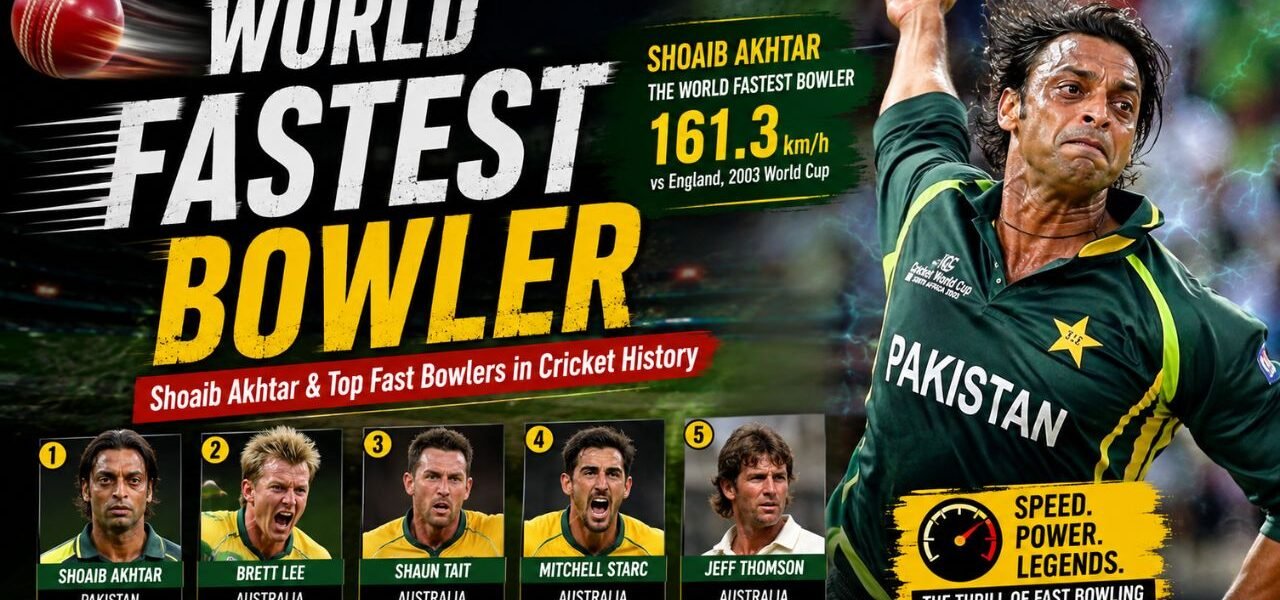

The world fastest bowler title is one of the most coveted unofficial records in cricket because that breathtaking excess velocity has always captivated admirers and brought batters from all around. The record, meanwhile, is rated as the quickest registered delivery in international cricket, and remains unchallenged by Pakistan bowler Shoaib Akhtar. The iconic pacer bowled a screamer 161.3 km/h (100.23 mph) towards England in the 2003 Cricket World Cup. His ability to bowl at breathtaking speed, alongside his aggressive run-up and terrifying presence made him one of the most recognizable fast bowlers in world cricket. His officially recorded speed is still the gold standard for maximum speed decades later amid technological progress and advances in sports science.
World Fastest Bowler Who?
Shoaib Akhtar is best known as being the fastest bowler in world cricket, as he holds the record for the fastest ball ever recorded in international cricket. During the 2003 Cricket World Cup, Pakistan fast bowler became the first player to reach that milestone against England. He clocked a speed of 161.3 km/h that put him well beyond the 160 km/h mark and into a select band of bowlers. According to Criczoo, the secret behind producing such magnificent velocity was Akhtar’s long and swift run-up, dynamic delivery stride, fit body and quick arm. The rawlplandi express, his nickname would become synonymous with savage pace and aggressive fast bowling becoming one of the most feared speed guns in cricketing history.
Record of 161.3 km/h with Shoaib Akhtar
When you talk about the world fastest bowler, Shoaib Akhtar does not have anything else more important than this delivery to show. He bowled a delivery measured at 161.3 km/h against England during the World Cup of 2003! What made it especially significant was that it happened in an official international match. Which may mean that this was more than just a practice-ball measurement; this came under the pressure of one of the world’s biggest sporting events. Akhtar was already one of Pakistan’s fastest bowlers, but the record made sure his place in history remained etched in stone. The extraordinarily limited reaction time of hitters against it and the incredible physical requirements of top-level fast bowling was illustrated by his extraordinary pace.
Fastest Bowlers in Cricket History
There have been many legendary pacers who took the art of fast bowling to its limits throughout the history of cricket. There were a precious few who had that divine gift of sustained pace, while most blended speed with movement, accuracy and tactical understanding. Exact rankings tend to fluctuate with the application of speed-gun technology and how specific recordings are made throughout cricket history, but following names crop up every time the fastest Bowlers in the game are mentioned. Shoaib Akhtar still holds the record for fastest delivery with an officially recorded 161.3 km/h, while Brett Lee, Shaun Tait, Mitchell Starc and other extreme fast bowlers have bowled balls over the 160 km/h barrier.
| Rank | Bowler | Country | Notable Speed |
| 1 | Shoaib Akhtar | Pakistan | 161.3 km/h |
| 2 | Brett Lee | Australia | 160.7 km/h |
| 3 | Shaun Tait | Australia | Around 160 km/h |
| 4 | Mitchell Starc | Australia | 160.4 km/h |
| 5 | Jeff Thomson | Australia | Around 160 km/h |
| 6 | Andy Roberts | West Indies | Around 159 km/h |
| 7 | Fidel Edwards | West Indies | Around 157 km/h |
| 8 | Mitchell Johnson | Australia | Around 157 km/h |
| 9 | Mohammad Sami | Pakistan | Around 156 km/h |
| 10 | Shane Bond | New Zealand | Around 156 km/h |
And recorded times vary from one competition to the next, as well as measurement systems, especially with older players.
Brett Lee: The Australian Express Fast Bowler
He was also one of the most exhilarating fast bowlers of his generation whilst being a major contemporary challenger to Shoaib Akhtar in the extreme pace stakes, Brett Lee. Consistently bowling over 145 km/h, the Australian pacer was capable of magnificent speeds when conditions and rhythm connected. Lee managed to clock an impressive 160.7 km/h delivery against England during the World Cup, in 2003. Despite the very lackadaisical gait of his run-up, his high arm speed and potent action could generate pace without seeming overly complicated. Apart from just speed, Lee showed accuracy and swing too, but his most important quality was attack mindedness making him a holistic fast bowler instead of merely a fast bowling spearhead.
The Bowling Name that Made a Statement — Shaun Tait: Mr. 200km/h
From the Australian bowlers, Shaun Tait was another bowler known for raw pace and an aggressive bowling action. His hair was unkempt and he hardly ever looked like a tall gangly bowler, in the category of lanky bowlers who use rhythm in their act rather than controlled movement—but it looked more like an all-out assault on the crease. His combination of pace, and awkward bounce made his deliveries a persistent threat for batters. He could soar into the 160 km/h range and was one of the quickest bowlers of his era. Tait’s career proved that serious speed can be a huge boon and also an awful burden. It can only be a product of elite fitness, superior biomechanics and adequately managing the workload of a lengthy cricket career.
Modern Day Fast Bowler And Its Issues With Mitchell Starc
By serving around a median, Mitchell Starc personifies the fast bowler of the 21st century and indeed he should — what he is doing is preserving an art that combines immense pace with craft and tactical nous. The Australian pacer who bowls left-arm has bowled above 150 km/h, including deliveries recorded over 160 km/h on the speed gun. Starc differs from most other pure speedsters in that he combines pace with swing, seam movement and accurate yorkers. Batters also face problems due to his left-arm angle, especially when the ball moves later on. So, although Shoaib Akhtar is still the officially recognised fastest bowler in history, Starc has demonstrated how the fast bowlers of today can fuse incredible speed with many other avenues of attack.
Extreme Pace: The Pioneer Jeff Thomson
Jeff Thomson (Picture: Craig Golding/AFP/Getty Images) One of the darkest forces fast bowlers in the 1970s and the man who put Australian cricket on its pace aggressive bowling par excellence. Alongside Dennis Lillee, Thomson made one of the most fearsome bowling partnerships in his time. The peculiar mix of a sling and natural delivery imparted enormous velocity and made his deliveries almost unreadable. Comparing bowling speeds of earlier eras can be problematic, as measurements were not standardised; Thomson was a contemporary bowler to both Richards and Nic Poole and comparisons should be treated cautiously. However, certain contemporary accounts and recorded measurements have often put Thomson among the fastest ever bowlers in cricket. You can see his imprint in the attitudes of later generations toward pace bowling.
What Gives a Bowler Extreme Speed?
Fastest Bowler in the World — You have to do a whole lot more than just running fast towards the wicket. A bowling pace is a consecutive chain of steps initiated by the legs then up through hips,hence trunk, shoulders and then arm&wrist involved in a very precise sequence. The fastest bowlers transmit that energy from their run-up through their bowling stride and then into the ball. To concern my point, physical strength does help but more than that technique and timing play a huge role. A finely tuned bowler can transfer momentum into ball speed much better than a mere physical brute. Together with athleticism and technical proficiency, that is why so few bowlers have ever bowled above 160 km/h.
Explosive Run-Up and Momentum
The run-up helps create that initial momentum before the critical delivery stride actually begins, so it is an important factor in producing bowling speed. Actually fast bowlers find their speed increase as they approach the crease, then release that energy right at the very end of the action. It has to be quick enough to create power with the run-up but also controlled enough that you can keep your balance and hit the ball well. Shoaib Akhtar had a notably long and mighty running stride. The fast-paced deliveries that he delivered to mark his way to the record earlier were generated with explosive acceleration while permitting him to board an attacking bowling rhythm.
Arm Speed and Release
One other primary factor that influences how fast the cricket ball comes out of the bowler’s hand is arm speed. The speed of the bowling hand increases considerably during the delivery action as it approaches the release point. The more quickly and efficiently that movement is made, the higher the potential ball speed. Quickly pitching the arm is grossly insufficient, however. It requires synchronization of front-leg position, shoulder rotation, torso rotation and wrist action in the bowler’s arm. Elite fast bowlers manage this coordination so seamlessly that it feels innate, a result of many years spent practicing and repeating the motion. The capacity to coordinate multiple body movements is one of the reasons why they are able to bowl at such high speeds.
Strength, Fitness and Biomechanics
Fast bowling tends to be a heavier workload on the body — particularly in terms of the lower back, hips and knees but also with shoulders and ankles. Thus, strength and conditioning is so important for everyone trying to bowl at elite speeds. Today, world class professional bowlers utilize highly structured fitness training programs geared towards developing strength, mobility and balance as part of an effective recovery plan. Biomechanics helps coaches discover movements that can be performed more efficiently or how to get rid of excessive stress on the body. The fastest bowler in the world title is related to speed but sustaining speeds over multiple deliveries also needs some physical conditioning. Any true speedy bowler can end up incurably erratic or injured without proper conditioning.
Is the Fastest Bowler Always The Best Bowler?
But to be the world fastest bowler does not do much towards honouring someone as the greatest fast bowler in cricket history. While speed is a vital tikka, bowling involves several more spices. The likes of accuracy, swing, seam movement, bounce variation, tactical awareness and consistency can be equally as important if not more than raw pace. A bowler who can bowl with the right length at 145 km/h may create more issues than a bowler who bowls 155 km/h, but without control. A lot of great fast bowlers in the history of cricket were not necessarily those who bowled the fastest but they became great because they know the conditions well, read batters and take wickets regularly.
An exceptional fast bowler usually requires:
- Zip and control to keep the batting line-up under pressure.
- Movement and fuzziness to create unpredictability in deliveries.
- Intelligence to counter the batter as well as the match situation.
Pace versus accuracy with Fast Bowlers
For a fast bowler, the classic debate of pace versus precision is an eternal one. Fireworks can be unsettling, make it difficult to see and cause the batter to slow their reactions relying solely on sheer raw speed without control though results in wayward deliveries leaking runs. A bowler builds the pressure and creates errors by being accurate. Most successful fast bowlers are a master of both. Shoaib Akhtar’s speed was incredible, however what made him even more threatening were his sudden uses of short balls, fuller deliveries and changes in angle. Even in modern cricket, the best pacers remain those who translate nippy speed into sustained wicket-taking menace.
Read also: Delhi Capitals vs Sunrisers Hyderabad Timeline | Most Handsome Cricketer in the World | Gujarat Titans vs Rajasthan Royals Timeline
Fastest Bowlers in Modern Cricket
In modern-day cricket, there have been many bowlers who can constantly bowl over 145km/h. The advancements in sports science, as well as nutrition and recovery methods and strength training allow professional pacers to develop a large physical capacity. In the last few years, bowlers like Mitchell Starc, Mark Wood, Anrich Nortje and Lockie Ferguson have become synonymous with high-speed bowling. Mark Wood, in fact, has a track record of breaking 150 km/h in international cricket. But the game today requires adaptability as well. Yorkers, bouncers, slower delivery and hard lengths that come in the arsenal of fast bowlers across formats where even a tight bowling schedule awaits them.
Mark Wood and the Next Generation of Quick Men
Out of the modern day crop of express bowlers, Mark Wood for England has morphed into one of the most recognisable names! With an uncomplicated short run-up, at times fierce aggression, and great pace with smooth transition in ball deliveries, he can bowl regularly in the range of 145–150 km/h with occasional surpassing yet. Wood has also demonstrated that he can be particularly effective in limited overs cricket when batsmen are looking to take the attack to him from ball one. His potential to either bowl a zippy short one that catches batsmen unaware or pound it into the stumps at full pace is viewed as an important weapon for England. He hasn’t yet gone past Shoaib Akhtar’s lead here, but his efforts show that the fastest men still have a very real part in modern cricket.
What Makes Fast Bowling So Difficult
Fast bowling is one of the more physically demanding skills in cricket (the bowler has to repeatedly create explosive strength while maintaining technical control). Each delivery puts pressure on several limbs, and the strain is of course immensely increased in Test cricket and international schedules. Fast bowlers also need to recover quickly between matches. For example, a player knows how to bowl very fast naturally but cannot sustain that pace over the years due to lack of conditioning. That’s why what bowlers who can maintain high speeds for long careers achieve is all the more impressive. Talented elite athletes, trained to extreme pace and with discipline can manage loads well though.
Evolution of Fast Bowling Technology
Bowling speed is measured and analyzed in so many ways than back in the days. Tracking technology available to modern-day cricketwas not available for previous generations. In the days of wishful thinking, speed guns, high-speed cameras and biomechanical analysis can give a lot now about what a bowler has done. Information such as release points, run-up speed, body alignment and movement patterns allows coaches to study technique. This technology has precise the conversations of world fastest bowler, since the speeds conducted today are recorded much more accurately, when comparing them across eras. Yet, historical comparisons should not be treated lightly since measurement systems have developed differently in different eras.
Thirty-Two Wickets Are Still Twenty Ahead Of Shoaib Akhtar’s Haul
This 161.3 km/h record is special because it was a blend of outright athletic prowess and the pressure from competition, as with many other field records held by individual athletes. It was not in solitary practice that he reached the mark; it was during a high-stakes international tournament against England. It was also the time when cricket produced some great fast bowlers, including Brett Lee and Shaun Tait. Hence, Akhtar’s tally became part of an interesting time in cricket when bowls tested the speed gadi continuously. No internationally recognized delivery has officially surpassed 161.3 km/h, so he retains the title of world fastest bowler.
Fastest Bowler in Test Cricket
Fast bowlers often need longer spells and matches to maintain their effectiveness, which makes Test cricket a more unique test of endurance To be a true Test cricketer, not only speed but endurance too. With the new ball, Pace can also generate breakthroughs whilst sustained high-speed bowling later in an innings could produce awkward bounce and pressure. Greats of the past, notable names such as Shoaib Akhtar, Brett Lee, Mitchell Johnson and Dale Steyn showed the huge benefit that comes with speed in Test cricket when matched up with control. You can also modify the length — and movement depending on primarily pitch, weather and condition of the ball (new/ worn/tired).
Fastest Bowler in T20 Cricket
Fast-bowlers also find it a different atmosphere in T20 cricket, where batters go on the attack off the first delivery. So top speed can thus be a key method of both defence and attack. Fast bowlers can employ a short-ball to have batters back on their heels or use yorkers at pace to deny runs towards the end of an innings. But variations are also necessary for T20 bowlers as batters hunt for the same predictable patterns all the time. Combine that with raw pace and you have modern express pacers increasingly using slower balls, cutters as well as changes of angle. This evolution demonstrates that while being the fastest bowler in the world is phenomenal, it isn’t but never guarantee success when it comes to making an impact in the shorter format.
World-Class Qualities of a Fast Bowler
Having a fast bowler of his caliber requires a great mix of physical capacity, technical ability & mental capabilities. While raw speed can easily turn heads, it is the consistency that makes a bowler reliable in every regard and across any format. Top pacers can do it differently depending on the pitch as well as batter and match situation. This includes knowing when to go for the stumps, when to bowl short and back away from the off stump as much as you can. These characteristics set apart the truly great fast bowlers from mere speedsters.
| Quality | Why It Matters |
| Pace | Reduces the batter’s reaction time |
| Accuracy | Builds pressure and limits scoring |
| Swing | Can beat the bat and produce edges |
| Seam movement | Creates uncertainty after pitching |
| Bounce | Makes defensive shots difficult |
| Variations | Prevents batters from predicting deliveries |
| Fitness | Helps maintain performance throughout a spell |
| Mental strength | Allows the bowler to perform under pressure |
Is Shoaib Akhtar’s Record Breakable?
Any time another bowler breaks the 161.3-km/h barrier it will always be of interest. Compared to many previous generations, modern athletes have access to better strength programs, nutrition, recovery systems and biomechanical analysis. They could be very helpful in getting a naturally talented bowler to some even quicker speeds. But it is still almost impossible to put up a time above 160 km/h. The bowler needs to generate massive forces over a matter of seconds all while remaining balanced, timing and a delivered action. Even if someone manages to break Akhar’s mark eventually, such a long-standing record would have been truly amazing as the 161.3 k/h benchmark has withstood the test of time through generations of international cricket.
Conclusion About World Fast Bowler
Ultimately, the tale of the world fastest bowler is a story about what humans can do. It is widely regarded as a milestone in professional human performance because it required extraordinary physical power, technical skill and competitive intensity. Several modern speedsters benefiting from advances in training, nutrition and sports science have come close but few have truly challenged his record. As for the race for extreme pace, brett lee and shuan tait gave way to Mitchell starc and Mark wood amongst other express pacers.
But cricket has proven that pace is not the only measure of greatness either. Pace alone will not do it for you — as the best fast bowlers use pace along with accuracy, movement, intelligence and consistency. Which is why the legacy of Shoaib Akhtar is more than one number on a speed gun. The delivery brought him into the limelight and made him an iconic face as world fastest bowler became one of cricket’s most exciting unofficial titles. The Rawalpindi Express holds the record for pure bowling speed, and that will remain the case until another international bowler is officially clocked at more than 161.3 km/h.
FAQs
1. Who is the world fastest bowler?
Shoaib Akhtar is the world’s fastest bowler, with an officially recorded speed of 161.3 km/h.
2. What is Shoaib Akhtar’s fastest ball?
Shoaib Akhtar’s fastest delivery was recorded at 161.3 km/h against England in the 2003 World Cup.
3. Who is the second fastest bowler?
Brett Lee is among the closest challengers, having recorded a speed of 160.7 km/h.
4. What is the fastest bowling speed in cricket?
The fastest officially recorded international bowling speed is 161.3 km/h, achieved by Shoaib Akhtar.
5. Can anyone break Shoaib Akhtar’s record?
Yes, a future fast bowler could potentially break the record, although crossing the 161.3 km/h mark is extremely difficult.
Read also: Lucknow Super Giants vs Gujarat Titans Timeline | Rajasthan Royals vs Gujarat Titans Timeline | Most Beautiful Women Cricketer